Deep Dive on Building Performance Standards Webinar Recap
In this webinar, we were joined by guest speaker Cliff Majersik, a senior advisor from IMT (Institute for Market Transformation), and our WatchWire sustainability analyst Prerana Tirodkar to discuss all things Building Performance Standards.
Agenda:
How do buildings fit into your climate policy
What are Building Performance Standards?
Managing Challenges and Opportunities
The road to compliance
Role of Energy and Sustainability Management Solution
To start off, we are pleased to officially announce WatchWire by Tango’s partnership with IMT, a nonprofit that catalyzes demand for high-performing energy-efficient buildings. Through our partnership, we will be helping our clients to navigate the complexities of local climate policies to reduce noncompliance penalties and to arm them with the education that they need on new rising building performance policies.
Why Buildings Matter
Building Performance Standards are the largest driver of investment in building performance in the United States right now. However, it is necessary to take a step back and understand why buildings matter- What is the larger impact?
We spend over 90% of our time in buildings; buildings significantly impact our health and wellbeing
Buildings account for 74% of U.S. electricity consumption and a third of national greenhouse gas emissions. You cannot address bold climate commitments without addressing buildings.
Energy waste contributes to higher energy bills, dirtier air, increased vulnerability to power outages and climate-related disasters
High performance buildings reduce energy, save money, and help achieve ambitious climate commitments
Currently, less than 2% of workplaces and schools, and less than 0.2% of homes receive an energy renovation or upgrade each year
To achieve climate commitments, the pace of building improvement must dramatically accelerate
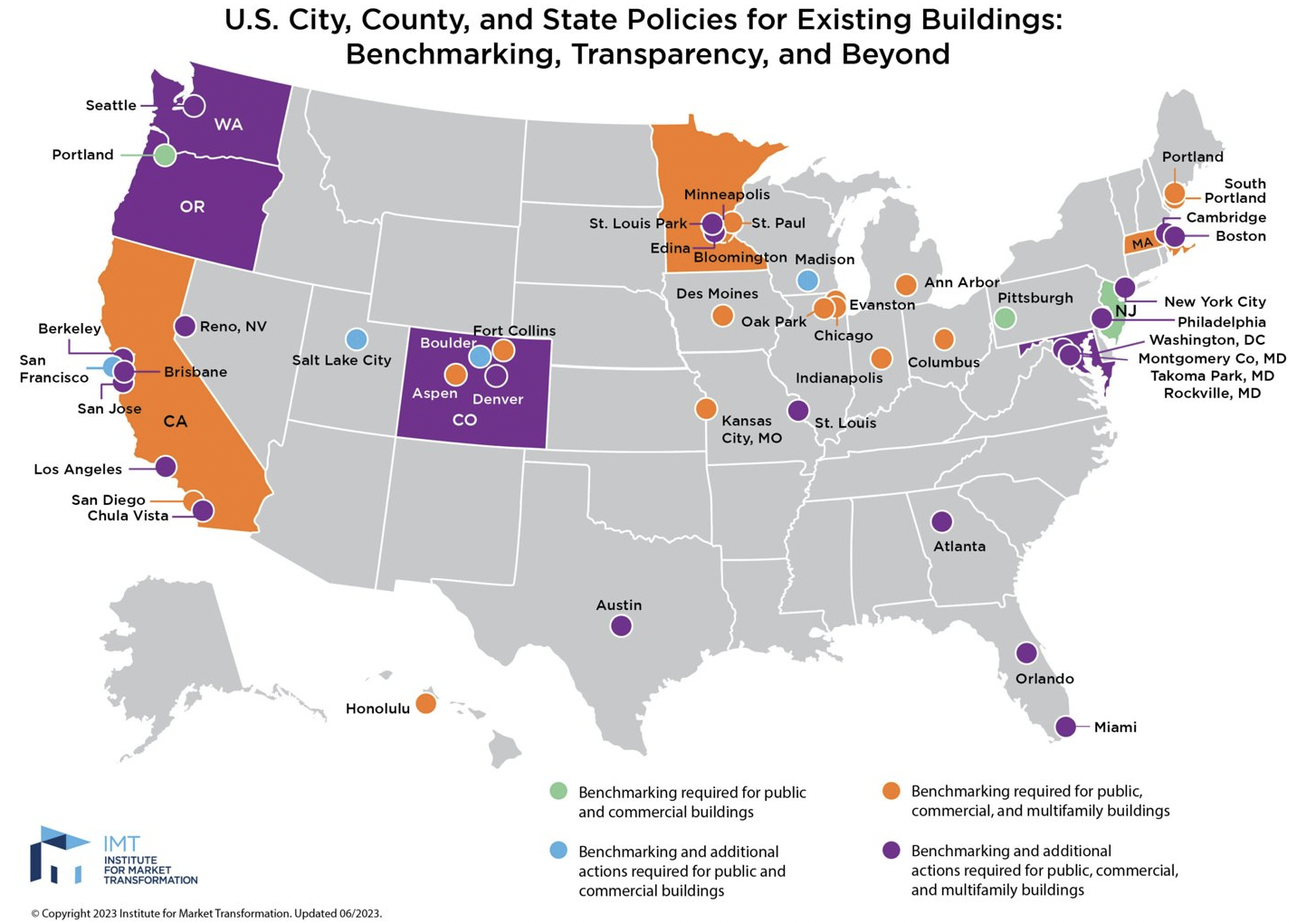
The landscape of benchmarking policies and policies in the U.S.
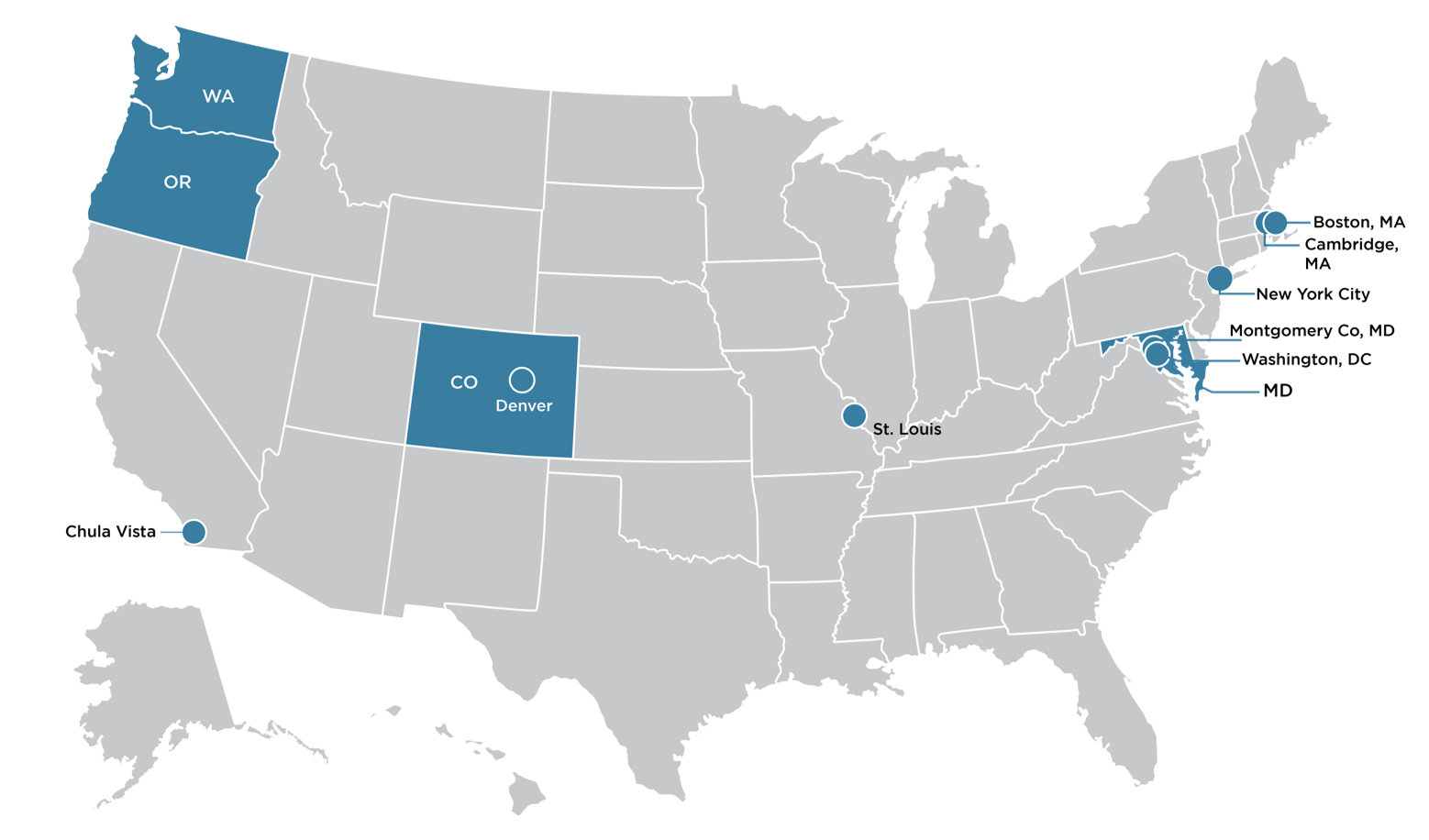
BPS Laws adopted in the U.S.:
There are currently four states, Washington, Colorado, Oregon, and Maryland, in addition to 8 localities (including major ones such as New York and Boston) that have passed official standards.
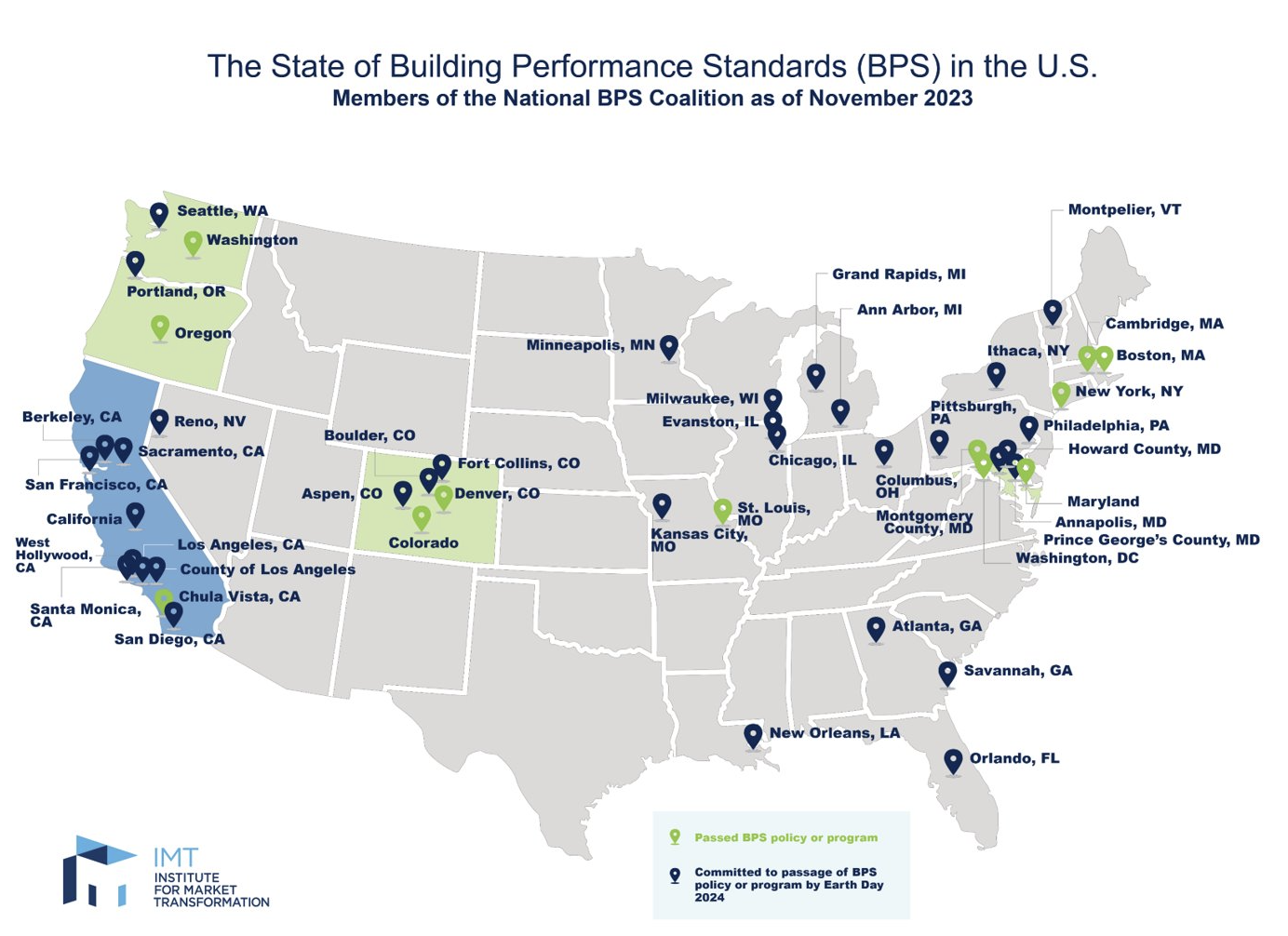
If you are in a jurisdiction that doesn’t yet have BPS, then the next step would be to look at this map to understand if your state or locality is committed to implementing them in the future. This is expected to be a growing wave over the coming years.
BPS Impact:
Building Performance Standards are the most powerful policy tool available to drive improved performance in existing buildings.
Washington, DC estimates that its BPS will reduce energy use in buildings by 20%, over 1M tons of CO2 annually
Washington State projects its BPS will reduce annual CO2 emissions by 14M tons by 2035
New York City projects a reduction of 6M tons of CO2 annually by 2030 and the creation of ~126,000 green jobs*
Expert panels predict the NYC energy retrofit market represents a mid-range market opportunity of $20B
What is a Building Performance Standard?
Establishes successively more ambitious requirements for building to improve performance across one or more quantitative objective measurements (e.g. to reduce site energy use intensity)
Applies to a large swath of public and private buildings over a certain size (usually 25-50k sq. ft.) on preset dates (no trigger needed)
BPS complements building codes. Building codes require that new buildings be built efficiently in the beginning, and standards come into force as soon as that building enters into operation.
What Makes a BPS Different?
Requires Improvement Across a Wide Range of Buildings
Drives Private Value-Creating Investment in Private Buildings
Yields Deep Retrofits at Scale
Sends Long-Term Signals with gradual preset dates
Balances Flexibility and Immediate Action
Provides Comprehensive Approach to Performance
The Business Case for ENERGY STAR (or high-performing) Buildings
5-16% Rental Premium per sq ft
6-31% Sales price premium
3-6% higher occupancy
Demand for Low Carbon Buildings Exceeds Supply
High Performance Buildings Are More Profitable
17% lower operating expenses per sq. ft. when compared to non-green properties
28% higher Net Operating Income (NOI) in green buildings
Key Takeaways for Service Providers
BPS are a huge and growing driver of demand for your services
Help your clients proactively position to profit from current and future BPS
Owners and operators will look to you for BPS guidance. So, get smart now on BPS requirements
Incorporate BPS into ROI calculations, etc.
Present solutions to enable long-term compliance with BPS
Include federal, state, and utility incentives and loans
Key Takeaways for Building Owners
Focus on benchmarking, understand BPS, begin now to incorporate building performance (e.g. EUI) into
Capital plans
Due diligence checklists
Performance-based leases (see greenleaseleaders.com for resources)
Performance specs for new construction
Job descriptions and evaluations for property managers, building engineers, etc.
Access federal, state, and utility incentives and loans
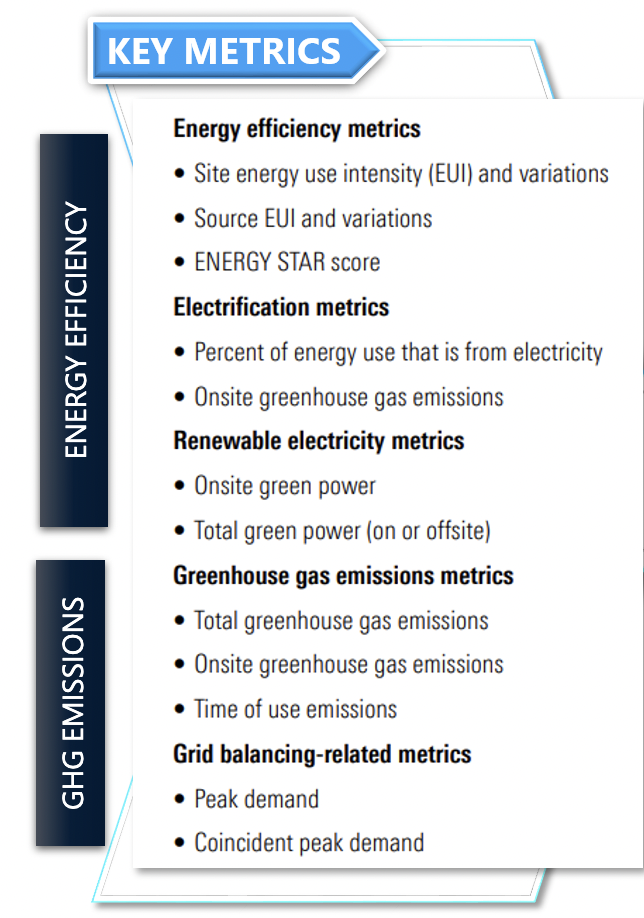
Know the key data metrics you need to track:
What to look for in an energy and sustainability data management software
It will be very difficult to comply with looming building performance standards and associated benchmarking ordinances without using unifying technology and a platform that facilitates the collection of energy and utility data, calculates carbon metrics, and reports investor-grade data within multiple areas, ready for audit scrutiny. WatchWire can help support the needs of property owners across all industries in their endeavors to decarbonize and retrofit their buildings and report on their progress. Facility managers and building owners have traditionally relied upon scheduled maintenance and planned operating schedules with little to no visibility into how energy-intensive equipment is performing on an ongoing basis across their sites. Sustainability managers or hired consultants may also employ the use of error-prone manual entry spreadsheets to complete emissions inventories, carbon accounting, and energy usage reports. Automated data capture and AI monitoring systems used to track and analyze the energy use, sustainability metrics, and efficiency projects of an organization will eliminate the liability risk and productivity loss associated with older methods of calculation and operations.
Features to aid in compliance:
Remote monitoring & diagnostics: detect and diagnose instances of energy waste and equipment faults in your portfolio with real-time monitoring
Automated, cloud-based data capture & storage
Energy and utility management baseline
Emissions calculations and inventory: Automate data acquisition, track GHG emissions based on the GHG protocol, maintain and update custom emissions factors, allow customization where desired such as with scope 2 market-based (or location-based) factors, on demand carbon inventory
Decarbonization Planning: Help with renewable energy procurement, and track onsite DERs (e.g. solar), RECs, and offsets within our system.
Goal Tracking: Track Progress toward net zero & and emissions reduction targets. Add absolute or intensity metrics with predetermined benchmarks or KPIs, track monthly or annually, add baselines and target year, real time monitoring
Comprehensively track sustainability metrics: energy consumption, emissions data & and accounting, water use, waste generation, renewables, space, budgets, and ownership
Guidance on compliance with local laws, ordinances, and building codes for green buildings and emissions reduction targets
Data auditing and assurance built in
M&V: M&V is a process for quantifying the precise impact on energy use of a conservation measure. It puts numbers into a difficult-to-quantify process and makes it easy to deploy efficiency measures, verify your emissions reductions efforts, and calculate the dollar impact for savings of an investment.
Compare building performance with performance benchmarking across your portfolio and against peers, and organize metrics based on geographic region, accounts, meters, and more
Sustainability reporting integrations: Compatible integrations with main reporting schemas, advice on reporting, and customizable financial grade report generation. As one of the most active ENERGY STAR service providers in the industry, WatchWire has a bi-directional integration with Portfolio Manager. We push and pull data to and from Portfolio Manager to automate reporting and compliance!
BPS Compliance Partnerships: Recently, WatchWire became a booster partner of the Institute for Market Transformation (IMT), meaning that our platform will provide programmatic identification of benchmarking and building performance standard policies that apply to each building across your portfolio. WatchWire users can then assess compliance pathways, potential penalties, or potentially stranded assets.
WatchWire by Tango is a market-leading, energy and sustainability data management platform that uses cloud-based software to collect, automize, and analyze utility, energy, and sustainability data metrics. WatchWire streamlines, automates, and standardizes your sustainability reporting process by integrating directly and/or providing reporting exports to ENERGY STAR Portfolio Manager, LEED Arc, GRESB, CDP, SASB, GRI, and more. The platform provides customizable dashboards, which allow asset managers, sustainability managers, engineers, and more to monitor individual key performance indicators (KPIs) and create custom views for specific use cases.
To discover more about WatchWire and its capabilities, you can visit our website, blog, or resource library, request a demo, or follow us on LinkedIn, Instagram, or Twitter to keep up-to-date on the latest energy and sustainability insights, news, and resources.
Navigating New AI Offerings Generative AI (GenAI) is set to revolutionize sustainability management by enhancing compliance, improving reporting accuracy, and streamlining resource allocation. Leaders in sustainability have recognized the transformative potential of GenAI to augment resource-stretched teams, enabling a sharper…
What Are Assertions and Audits? Audit and verification are the processes of examining and verifying the accuracy, completeness, and reliability of data and information and assurance is the deliverable or outcome of the audit. There are different levels of assurance,…
Key 2024 Updates for LL97 Compliance 1. New Reporting Platform: BEAM Building Energy Analysis Manager (BEAM) is now the main reporting portal for all LL97 submissions.BEAM will handle both annual (Article 320) and one-time (Article 321) compliance submissions. 2. Filing…

 Log In


 Top Sustainability Trends to Watch in 2025